




Summary
Fraunhofer IWU set to improve the efficiency of electronic cooling systems. The study aimed to explore how advanced materials, combined with generative design software, could deliver superior cooling performance in compact heat sink designs suitable for servers and power electronics.
The team dramatically accelerated the design cycle, achieving a 6% improvement in thermal performance and 30% faster production.
This study highlights how physics-driven design and next-generation materials can reshape thermal management for servers, power electronics, and high-density applications, delivering faster, more efficient, and scalable cooling solutions.

Background
Fraunhofer IWU set out to develop advanced cold plates to meet the growing demand for compact, efficient thermal management in next-generation electronics. With increasing power densities in modern devices, traditional cooling solutions struggle to balance performance, manufacturability, and cost-effectiveness.
Modern electronics require cooling solutions that:
- Fit within constrained enclosures while maintaining high efficiency.
- Minimize pressure losses to reduce pumping power.
- Support multiple cooling methods (liquid or air, free or forced convection).
- Enable rapid iteration and scalable production for faster market launches.
However, conventional materials and design workflows—such as AlSi10Mg, optimized for casting—face performance and manufacturing speed limitations. Fraunhofer IWU sought to overcome these barriers by integrating:
- Constellium’s Aheadd® CP1 alloy, designed for laser powder bed fusion (LPBF), offering superior thermal conductivity, mechanical strength, and corrosion resistance.
- ToffeeX’s physics-driven generative design software which employs physics simulations to guide the engineering process and can optimize fluid flow, heat dissipation, and manufacturability in a single iterative process.
The objective was to determine if this approach could reduce development time, lower costs, and deliver a superior cold plate.
Implementation
Material-driven Generative Design
Fraunhofer IWU leveraged ToffeeX to optimize the cold plate design for two distinct cooling mechanisms:
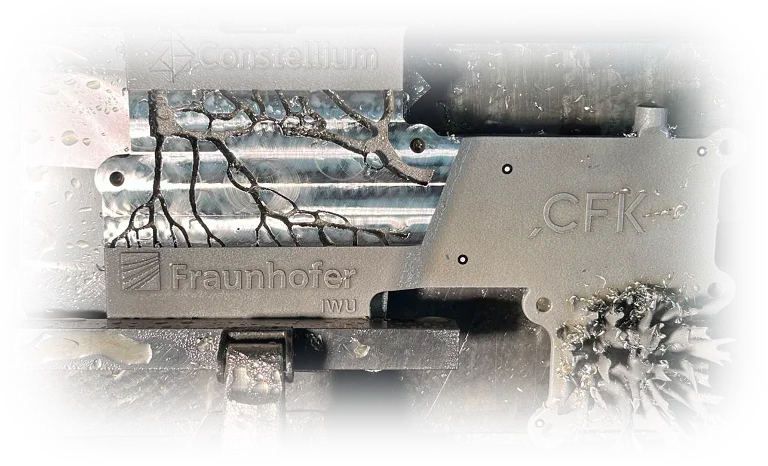
- Liquid-cooled section: Optimized water channels were sculpted to reduce pressure drop while maximizing heat transfer for three high-power heat sources.
- Natural convection section: ToffeeX generated organic fin-like structures to enhance passive heat dissipation.
Benchmarking CP1 vs. AlSi10Mg
To validate CP1’s advantages over AlSi10Mg, Fraunhofer IWU evaluated its thermal conductivity, density, mechanical properties, additive manufacturing performance, and post-processing efficiency.
| Material | Layer Thickness | Laser Power | Heat Treatment Time | Printing Time Reduction |
| CP1 | 90 µm | 700 W | 4 hours at 400°C | 30% faster |
| AlSi10Mg | 25–50 µm | Variable | 13 hours (multi-step T6) | – |
Optimizing the design workflow with ToffeeX
Using ToffeeX, Fraunhofer optimized the heat sink to:
- Reduce the pumping power self-consumption.
- Leverage material properties – allowing bespoke optimizations also for novel technologies.
- Balance multiple heat transfer methods in a single component.
- Optimize manufacturability by embedding LPBF constraints directly into the design.
- Accelerate design iterations—going from concept to a manufacturable file in hours instead of weeks.
Results
Fraunhofer IWU’s study confirmed that combining ToffeeX’s generative design and Constellium’s Aheadd® CP1 alloy significantly outperformed conventional materials and workflows across key performance areas.
1. Faster design iteration & engineering workflow
- 3x faster design iterations—from 1 per day (traditional CAD) to 3 per day using ToffeeX.
- Automated physics-driven design eliminated manual trial-and-error in CAD modeling.
- Integrated LPBF constraints within the design process

2. Manufacturing efficiency
- The design-to-production cycle was reduced to under 2 months, compared to industry norms of 6+ months.
- 30% faster printing—CP1’s optimized parameters reduced LPBF build time from 20 hours to 14.
- 70% shorter heat treatment cycle—CP1 required only 4 hours vs. 13 hours for AlSi10Mg.
- Less print distortion—ToffeeX’s fluid topology optimization reduced stress concentrations.
3. Superior thermal performance
- 6% higher heat dissipation reduced CPU/GPU operating temperatures and improved reliability.
- More uniform temperature distribution minimized hotspots in high-power applications.
- Lower pressure drop, optimized internal flow paths, and improved cooling efficiency.

4. Cost reduction & scalability
- 25% lower printing costs due to reduced build time and energy consumption.
- Fewer support structures are required, reducing material waste and post-processing time.
- Improved manufacturability, ensuring a seamless transition from generative design to production.
Aheadd® CP1 compared to AlSi10Mg
| Property | Aheadd® CP1 | AlSi10Mg |
| Thermal Conductivity (W/m*K) | 210 | 170 |
| Ultimate Tensile Strength (MPa) | 340 | 320 |
| Elongation (%) | 13% | 10% |
| Density (kg/m³) | 2700 | 2670 |
| Heat Treatment Time (hours) | 4 | 13 |
| Printing Time Reduction | 30% Faster | – |
Why ToffeeX for cold plate design with advanced materials
- Material compatibility: ToffeeX incorporates new alloys like CP1, ensuring accurate simulation and geometry generation
- Manufacturing integration: Incorporating LBPF (or other manufacturing) constraints early on reduces post-optimization adjustments and expedites the path to production.
- Physics-driven design: Engineers rely on real-world physics rather than guesswork, achieving a faster route to valid designs
- Complex geometry made simple: Rather than manually iterating multiple designs, ToffeeX outputs near-final forms that only require basic CAD finishing.
- Multi-method cooling solutions: Allows the inclusion of different heat transfer methods and fluids while minimizing pumping power.
- Flexible objectives: accommodates multiple inlets/outlets, variable flow rates, and different cooling mechanisms in a single optimization framework.
- Multi-objective flexibility: Users can fine-tune various parameters—flow rate, pressure drop, temperature gradient—to meet specific design targets.
- Streamlined workflow: Engineers save time by merging design and simulation into one environment, accelerating the path from concept to final product.
Conclusion
This case study underscores the value of pushing beyond standard materials and design methods. As electronics industries demand ever-greater power densities, new approaches to cooling hold immense promise.
By combining Constellium’s high-performance CP1 alloy with ToffeeX’s physics-driven generative design, Fraunhofer IWU delivered a fully optimized cold plate in under two months. The new system passed stringent mechanical and pressure tests and exhibited marked improvements in heat dissipation. The straightforward heat treatment further makes CP1 an attractive choice for manufacturers prioritizing faster turnaround times. The result is a tangible leap in thermal efficiency, reduced printing times, and lower overall costs.
This benchmark in material-driven cold plate design sets a strong precedent for future innovations in electronics cooling, offering improved cooling, cost efficiency, and faster time to market for advanced electronic systems.
About Fraunhofer
Fraunhofer IWU is a pioneering research institution that develops cutting-edge technologies for resource-efficient manufacturing, mechatronic systems, and forming processes. As part of the Fraunhofer-Gesellschaft—Europe’s largest organization for applied research—Fraunhofer IWU collaborates with industry partners to transform ideas into practical solutions that enhance productivity, quality, and sustainability. The institute continually pushes boundaries through advanced R&D, fostering engineering excellence and contributing to the ongoing evolution of manufacturing worldwide.
About Constellium
Constellium is a global leader in developing and manufacturing high-value-added aluminum products and solutions. With a rich heritage spanning decades, the company partners with customers across industries such as aerospace, automotive, and packaging to create applications that help shape the future of design and engineering. Through significant investment in research and development, Constellium continually pioneers new technologies while strongly emphasizing safety, quality, and environmental stewardship.