


Introduction
LNG custody transfer depends on precision. Even minor inconsistencies in vaporization can skew gas sampling and impact pricing, compliance, and downstream processing.
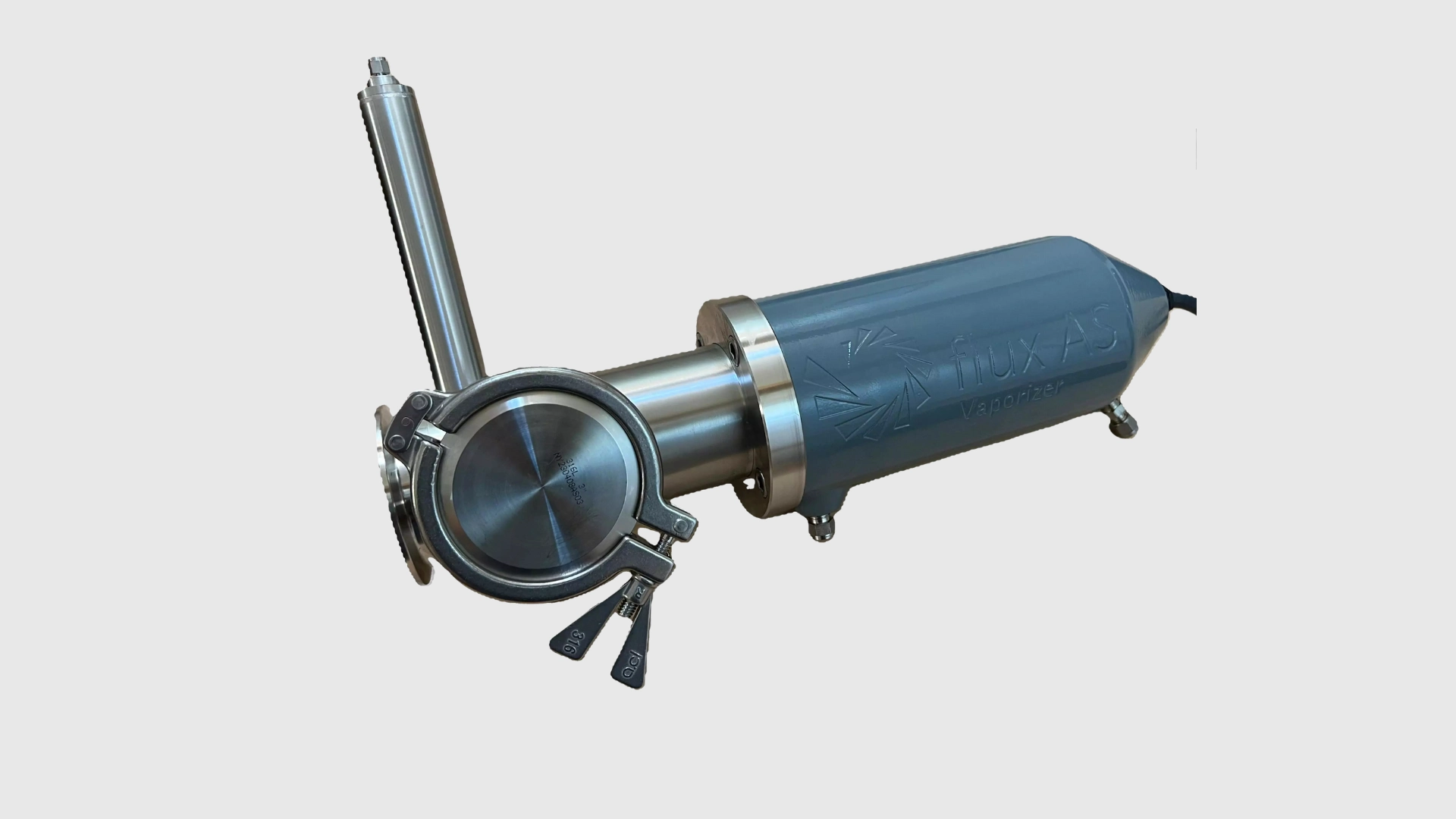
This case study features an additive-manufactured LNG vaporizer, developed by a cross-industry team and designed using ToffeeX’s physics-driven generative design platform. During field testing at Equinor’s Hammerfest LNG terminal, the new design reduced measurement variability by 50%, improving Gross Heating Value (GHV) and Wobbe Index stability — two metrics critical to LNG trade.
The project optimized the internal thermo-fluid architecture of the vaporizer, delivering a monolithic, manufacturable design with integrated insulation cavities, self-supporting geometry, and proven real-world performance.

Background: Why LNG vaporization matters
Liquefied natural gas (LNG) is transported at cryogenic temperatures (around –160°C) and low pressures. Before analysis can occur for custody transfer or quality control, LNG must be fully vaporized and sampled as a gas. However, non-uniform vaporization can cause phase separation, leading to inaccurate readings of energy content.
These inaccuracies compromise custody transfer, regulatory compliance, and commercial confidence.
Project goals
The objective of this project was to develop a next-generation LNG vaporizer that:
- Reduces heat ingress before vaporization
- Minimizes heat loss during the vaporization process
- Ensures complete and uniform vaporization
- Maintains low pressure drop
- Integrates easily with existing LNG infrastructure
To meet these requirements, the design needed to combine physics-driven design optimization with additive manufacturing.

Collaboration across disciplines
A multi-organization consortium delivered this additive-manufactured LNG vaporizer project:
- IKM Flux led the system integration and testing
- Jiskoot Solutions developed the vaporizer concept
- Valland produced the component
- Intertec supplied and certified the integrated heating element
- EOS contributed to the additive manufacturing process development
- ToffeeX provided the generative design software
Design evolution: optimizing the additive-manufactured LNG vaporizer
ToffeeX’s platform was used to explore multiple performance objectives and manufacturability constraints in parallel. Using AI-enhanced generative design, the team rapidly iterated through a series of simulations, refining the geometry for:
- Heat transfer near the core heater
- Pressure drop optimization
- Homogeneous vapor output
- External insulation
- Additive manufacturability
Each design iteration built on the previous one to balance thermal performance, flow behavior, and real-world constraints.

Step 1: Heat transfer optimization
The process began with a coaxial cartridge heater at the center of the domain. ToffeeX optimized the surrounding geometry to maximize convective heat transfer and minimize pressure drop. This resulted in a spiral structure that extended the LNG’s residence time near the heat source, while maintaining smooth flow paths.

Step 2: Early vaporization and uniformity
The next iteration prioritized front-loading the heat transfer—concentrating more thermal energy in the inlet region. This approach enabled earlier phase change from liquid to gas, while downstream mixers ensured temperature uniformity. The updated spiral became tighter, with integrated turbulence elements to enhance mixing.

Step 3: Real-world insulation and boundary conditions
To reflect cold ambient conditions at sites like Hammerfest, the team introduced vacuum insulation cavities and updated the optimization constraints to account for convective losses to the environment. The number of spiral paths was reduced, and wall spacing was increased to insulate the vaporizer’s core from external cooling.

Step 4: Manufacturing refinement and lattice integration
To reduce weight, cost, and build time, the team replaced bulk material in non-functional regions with lattice structures using implicit modeling tools. This helped limit heat loss while improving the component’s mechanical efficiency. At this stage, powder removal ports, structural reinforcements, and print-friendly geometry were also finalized.

Design for additive manufacturing
ToffeeX’s output was converted into a parametric CAD model using Rhino/Grasshopper and prepared for printing using EOS software. The lattice structures were created with nTop and processed natively in the EOS workflow, eliminating the need for intermediate STL conversion.
The final design was printed by Valland on an EOS M290 in AlSi10Mg, with a build height of 279 mm. Despite this complexity, the component was entirely self-supporting, requiring no internal supports, thanks to ToffeeX’s print-aware optimization workflow. Vacuum insulation cavities and powder evacuation channels were built directly into the part.

Results and validation
The additive-manufactured LNG vaporizer underwent field testing at Equinor’s Hammerfest LNG terminal in March 2025. Compared against a legacy system in a like-for-like installation, the new design demonstrated:
- 50% reduction in the standard deviation of Gross Heating Value (GHV)
- Improved stability in Wobbe Index measurements
- Consistent results across flow rates up to 1200 SL/hr
- Seamless integration into existing infrastructure
The performance boost directly enhances confidence in LNG custody transfer, where accurate and stable energy readings are critical.


Conclusion
This additive-manufactured LNG vaporizer project demonstrates the potential of integrating generative design with production-ready additive manufacturing in the energy sector. The new vaporizer is not only a drop-in retrofit solution, but also a blueprint for future-ready component engineering.
Key outcomes:
- 50% lower variability in GHV readings
- Validated in-field performance at a major LNG terminal
- Retrofit and new-build compatibility
- Integrated insulation and powder management features
- Self-supporting design with no internal supports
Technical highlights
- ATEX-compliant vaporizer assembly.
- Physics-driven fluid and thermal topology optimization
- Multiphysics objectives: heat transfer, pressure drop, phase change, manufacturability
- Monolithic, additively manufactured geometry
- Implicit modeling of lattice structures for insulation
- Certified 500W heater cartridge embedded in a steel support rod
About the Consortium
About IKM
IKM The IKM group is a multidisciplinary supplier to the Norwegian energy industry. Through its IKM Flux division, the company develops solutions for subsea and topside flow systems, with a strong focus on safety, reliability, and regulatory compliance in fluid handling and measurement.
About Valland
Valland is an Italian manufacturer specializing in high-quality valves and components for the energy, oil, and gas sectors. With in-house additive manufacturing capabilities, Valland enables rapid prototyping and production of complex parts, bridging innovation and real-world application.
About Intertec
Intertec designs and manufactures advanced enclosures and protection systems for field-mounted instruments in harsh environments. Their engineered solutions include explosion-proof and weather-resistant systems, often incorporating integrated heating for temperature-sensitive equipment.
About EOS
EOS is the leading technology provider worldwide for industrial 3D printing of metals and plastics. They are pioneers and innovators for integrated solutions in AM and have mastered the interactions between lasers and powder materials.
About Jiskoot Solutions
Jiskoot Solutions is a trusted provider of high-precision sampling and blending systems for the oil and gas industry, specializing in custody transfer and process measurement.
About ToffeeX
ToffeeX is the leader in physics-driven generative design. Their AI-powered software uses physics to guide the design process, empowering engineers to create optimized products that meet all their requirements in a matter of hours.