



Summary
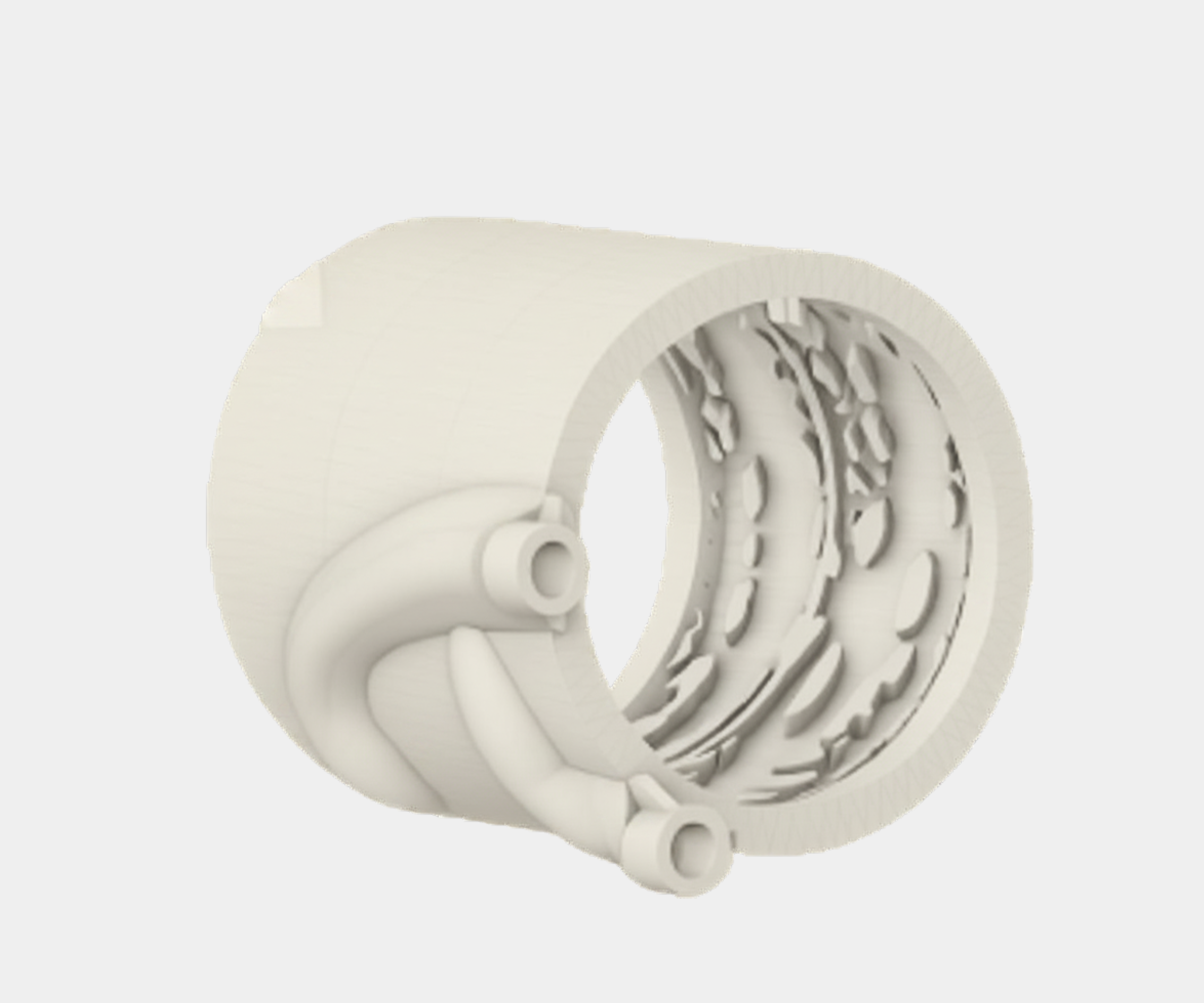
Using ToffeeX, the Chalmers Formula Student team redesigned the water cooling jacket for their electric race car’s motor to better handle peak thermal loads. Starting from their previous season’s helical-channel design, the team used ToffeeX’s physics-driven generative design platform to re-optimize the jacket’s internal fin geometry against a 1,400 W peak heat load.
The resulting designs reduced the maximum motor-interface temperature by up to 5.4 °C and the average temperature by up to 4.2 °C compared with the previous jacket. Rather than a single output, ToffeeX generated a family of designs spanning the classic thermal-vs-hydraulic trade-off, giving the team explicit control over how much cooling performance to buy for a given pressure drop.

The geometry was shaped for additive manufacturing from the start: fins were extruded at a 45° angle so the part prints without support structures, and any fin thinner than 3 mm was removed to respect the process’s minimum feature size. The result is a high-performance, directly printable cooling jacket, designed in a fraction of the time a manual fin study would have taken.
Designing a water cooling jacket for an EV motor under 1.4kW peak load
In a Formula Student electric car, the motor is one of the most thermally stressed components on the vehicle. During the dynamic events, the motor is repeatedly driven toward its peak output, and the heat it rejects must be carried away fast enough to keep it inside its safe operating window. If the motor interface runs too hot, the team has to derate power, which negatively affects lap time.

The team cools the motor with a water cooling jacket: a cylindrical component that wraps the motor and routes coolant through internal channels to pull heat out of the motor housing. The previous season’s design (referred to here as CFS25) used a helical coolant path around the cylinder. It worked, but the team identified that it could be optimized to better handle peak thermal loads when the motor is working hardest and cooling matters most.
The design target for the new season was clear: keep the motor interface cooler at peak load, without an unreasonable penalty in pumping power.
Designing the cooling jacket with ToffeeX
ToffeeX is a physics-driven, multi-objective generative design platform. Based on user-defined weightings between heat transfer and pressure loss optimization objectives, ToffeeX selectively adds or removes solid material across the design domain at each iteration, placing cooling structure only where the physics says it delivers value. For a component like a motor water-cooling jacket, where the team wants maximum heat extraction with minimal pumping penalty, this targeted use of material is exactly the lever they need.

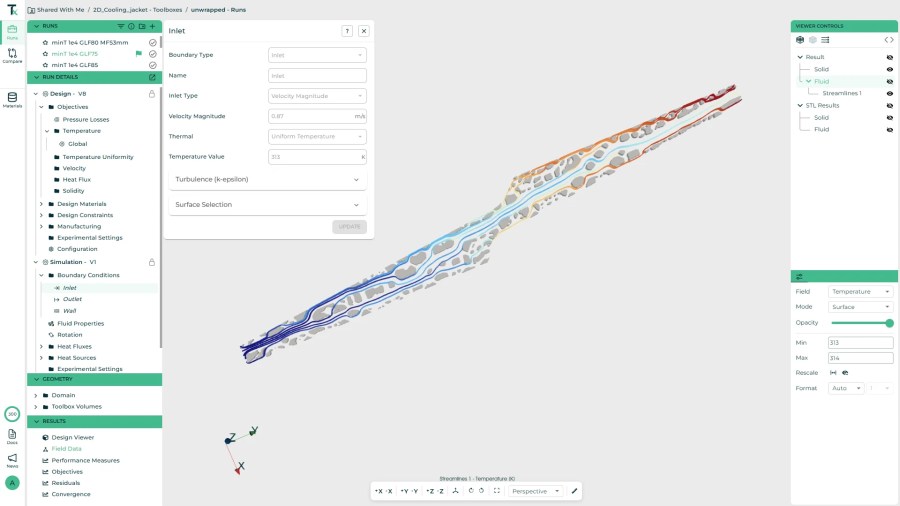
The team’s first approach was to simplify the jacket, unfolding it into a 2D domain, and simulate it against the 1,400 W peak load.
Watch the webinar Master Physics-Driven Generative Design for Thermal Systems to see more about this approach!
Working in 2D lets ToffeeX run through design iterations quickly and explore the solution space for designs with no third-dimensional complexity.

The team kept the proven helical path of the CFS25 design and used ToffeeX to optimize the fins along that path, focusing the optimization where it added the most value rather than re-inventing the overall architecture.
The design domain is simplified to comply with the 2D Extruded approach required to run the optimization in ToffeeX.
Designing for additive manufacturing from the start
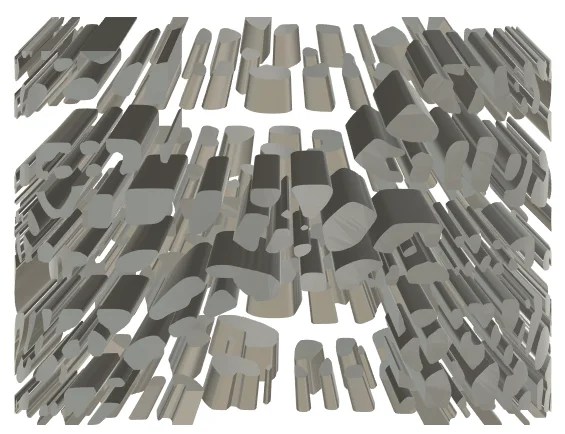
The selected optimized 2D fin pattern was wrapped back onto the 3D cylinder to form the jacket, and then two manufacturing constraints were baked directly into the geometry:
- Self-supporting fins: the fins were extruded at a 45° angle so the jacket could be metal 3D-printed without support structures. Supports inside a sealed cooling channel are impossible to manually remove, so a self-supporting overhang was essential for a printable part.
- Minimum feature size: an embedded manufacturing constraint was considered during the topology optimization process, preventing any fin from being smaller than 3 mm, above the reliable minimum for the additive process to avoid thin, unprintable, or fragile structures.
The outcome is a jacket whose high-performance internal geometry is also a clean, printable part: the performance gain and the manufacturability are designed together, not traded against each other after the fact.

Results
To compare designs, the baseline CFS25 jacket and the selected ToffeeX-optimized jackets were simulated in ToffeeX (yes, it can also be used for CFD only) against the same 1,400 W peak load. The table below reports the maximum and average temperatures at the motor interface, together with the pressure drop across the jacket.
Despite a limited number of iteration cycles before the project deadline, the final topology-optimized water cooling jacket outperformed the previous CFS25 design in terms of temperature.
Table 1: CFS25 baseline vs. ToffeeX-optimized water cooling jackets
| Design | Temp. objective (wₜ) | Fluid fraction | Solid fraction | Pressure drop | Max temp (motor interface) | Avg temp |
|---|---|---|---|---|---|---|
| CFS25 (baseline) | — | — | — | 3,800 Pa | 66.0 °C | 61.1 °C |
| ToffeeX — Te1e4 / GLF80* (balanced) | 1e4 | 80% | 20% | 5,000 Pa | 61.1 °C | 57.6 °C |
| ToffeeX — Te5e5 / GLF70* (max cooling) | 5e5 | 70% | 30% | 11,000 Pa | 60.6 °C | 56.9 °C |
*ToffeeX designs names were assigned by the team based on the thermal objective weight and the fluid volume fraction
Both ToffeeX designs run cooler. The balanced design (Te1e4 / GLF80) drops the peak interface temperature by 4.9 °C (66.0 → 61.1 °C) and the average by 3.5 °C, for a moderate rise in pressure drop. This design was chosen for manufacturing. The more “aggressive” design (Te5e5 / GLF70) goes further — 5.4 °C lower peak and 4.2 °C lower average — at the cost of a much higher pressure drop.
Conclusion
For the new season’s car, ToffeeX let the Chalmers Formula Student team take a working but conservative cooling jacket and re-optimize its internal geometry to run measurably cooler at peak load, while keeping the part directly printable via additive manufacturing,

The broader takeaway: a small student team, working to a hard deadline, used physics-driven generative design to produce a better-performing, additively manufacturable cooling component than its hand-designed predecessor, and to do it as a tunable design family rather than a single lucky guess.