

How the Seed Design Constraint Transforms Your Topology Optimization Workflow
Generative design algorithms are incredibly powerful, but without direction, they can wander. You start with a brilliant design challenge, run your favourite optimization solver (…which is clearly ToffeeX), and get something that you would probably define as unconventional.
On paper, it is “optimal”.
In reality, you still have to ask:
- Can this be manufactured with real processes?
- Will it pass certification and inspection?
- Does it resemble anything your team is willing to put into production?
This is where many organisations hit a wall. They end up stuck between two frustrating worlds:
- Traditional, incremental tweaks – predictable but slow, with limited performance gains.
- Unconstrained generative design – exciting on screen, but risky, hard to qualify, and often disconnected from manufacturing.
ToffeeX introduces a third way: Seed Design Constraint.
ToffeeX’s seed design constraint changes the game by introducing smart control into the design exploration process. Instead of letting your optimization algorithm roam freely through the solution space, you guide it, anchoring it to your existing industrial knowledge while still unlocking real innovation.
Engineering Intent Meets Physics
The idea is simple yet powerful. You feed your existing component – your seed design – into the topology optimization process and set a maximum allowable deviation from that geometry. The optimizer is free to explore, but only within boundaries you define.
(For a broader view on why this matters, see our post on Human-Centered Generative Design in an AI-Driven World.)
So instead of asking:
“What is the absolute optimum, no matter how alien it looks?”
you ask:
“What is the best design we can achieve while staying close enough to be manufactured, certified, and integrated?”
Here, “deviation” means the maximum geometric difference from the seed design across the design domain. You choose how far the new design is allowed to move away from your current geometry.
Under the hood, the algorithm still solves the full physics – reducing pressure losses, improving heat transfer, minimizing mass – but every iteration respects the seed constraint. Optimization serves engineering intent, not the other way around.
A Concrete Example: The Fuel Injector
Consider a simplified duplex fuel injector for aerospace applications, optimized to minimize pressure losses while maintaining performance.

With fully unconstrained topology optimization, you might obtain a design with very aggressive flow expansion. It performs well, but may be too heavy, hard to manufacture, and difficult to certify for an aerospace environment.

Even if this is the mathematical optimum, would you pick it as it is?
Now add a seed design constraint around 30% deviation and the picture changes. The optimizer still finds better flow paths: the flow splits more efficiently, rear channels help recover impingement losses, and overall pressure drop improves. But the geometry remains recognisable.
It is still an injector that your manufacturing and certification teams can work with.
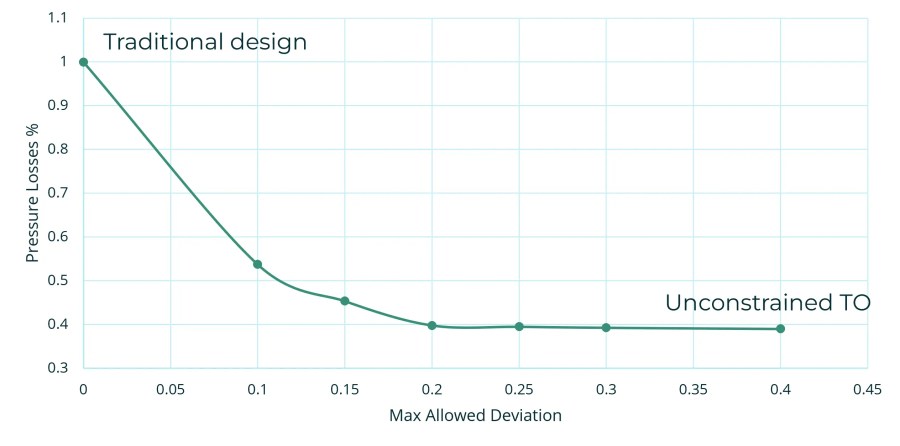
Tighten the deviation to 10% and you obtain more subtle changes: smoother transitions, refined channel shapes. The new design looks almost the same as the seed to the naked eye, but is measurably better in terms of physics.


By sweeping the deviation parameter, you do not just collect designs, you build understanding:
- Which deviation levels deliver meaningful performance gains?
- Which geometric features are actually driving that improvement?
From the plot below, we see how a mere 10% variation from the original design already provides most of the benefit in terms of pressure losses. In other words, you can stay very close to a design you already know how to certify and manufacture, while still gaining a significant performance boost.
Why the Seed Design Constraint Matters
Manufacturability by design
Your seed design carries accumulated manufacturing knowledge. The constrained optimization preserves this, so results are inherently more practical. No more designs that look perfect in simulation but can be a nightmare to manufacture.
Design families, not one-off solutions
By varying the allowed deviation, you generate a family of related designs. A 30% deviation may produce one solution; 10% reveals a different one. Instead of a single “best” shape, you build a feature map to understand how design choices drive performance.
Faster iteration when requirements change
When project requirements change, the seed design constraint prevents you from restarting from zero. The previous optimum becomes the new seed. You recycle proven solutions, adapt quickly to new conditions, and shorten development cycles.
A better fit with real workflows
Many new generative tools live in their own bubble, far from CAD, PLM, and CAM. Seeded optimization respects existing digital assets and design intent. You build on top of your current models, data, and processes.
Beyond “Traditional vs Generative”
Framing the choice as traditional design versus generative design misses the point.
Engineering has always been about balance: between innovation and feasibility, performance and manufacturability, speed and reliability.
The seed constraint does not abandon optimization; it matures it. It says:
Yes, explore boldly. But do it intelligently.
This is what ToffeeX brings to the design process: physics-driven optimization that respects engineering reality. Not black-box AI guessing. Not designs that look stunning in PowerPoint and impossible in production.
The best design isn’t the most extreme one. It’s the one that works.