


There is a moment, with any new engineering method, generative design included, when the conversation changes. It stops being about whether the idea is clever and starts being about whether it ships. Whether it survives contact with a regulator, a production line, a cost model, a quality audit. Whether it holds up when someone’s name is on it.
At our first ToffeeX Summit, held in London last week, that moment arrived in the room.
Around forty engineers flew in from Japan, South Korea, Norway, Germany, Belgium, Italy, the US, and across the UK to spend a day together; some travelling more than fifteen hours to be there.
They came from Rolls-Royce, Toyota, Airbus, Fraunhofer, EOS, Ricoh, IKM, SOLIZE, SCSK, Bi-Rex, bp, and Alloyed, among others. And what they shared, one after another, was not a set of promising concepts. It was production parts, validated tools, and working systems already fulfilling orders.

From a single lift to a full room
Before the talks began, one of our team members made a remark that stuck with us. Riding the building’s very small lift, packed in with a group of clients, he observed that not long ago the entire ToffeeX team could have fit comfortably inside it.
A few years is not a long time. But it was long enough to go from a company that fit in a lift to a community that fills a room. A room of engineers from some of the most demanding companies in the world, comparing notes on the same hard problems. That is the context worth holding onto as you read what follows: none of these results existed a short while ago, and most were, until recently, considered impractical.

The through-line across the day was simple. Physics-driven generative design coupled with additive manufacturing has moved from the “interesting demo” phase into the “in production” phase for thermal-fluid systems.
Aerospace and defense: designing what you can also justify
Nikolaus Milaev, representing Fraunhofer IWU in Dresden, opened by grounding the day in thermal management. His point was practical: it is not enough for a heat exchanger or a vapor chamber to be printable, it has to be reproducible at an industrial level, and it has to move heat more efficiently than the alternatives. He walked through two-phase passive cooling capable of moving on the order of 100 watts per square centimeter, and a vapor chamber project, run with partners in Denmark, that transferred around 600 watts away from a GPU.
The message: the physics is understood, the designs work, and the task now is manufacturing maturity, more lasers, better beam shaping, the right design for the right material. And tools like ToffeeX can generate the best-performing designs.

Danny Duder of Rolls-Royce took the argument into one of the most safety-critical environments there is. His team explored generative design for components whose function depends on fluid flow and heat transfer, showing a design that cut pressure loss in a flow component by around 40%.
But the more striking part of his talk was not the number — it was the honesty about everything that has to happen around the number. In a regulated setting, a beautiful optimized geometry is only useful if you can inspect it, simulate it accurately, understand what thermal expansion will do to it, and present it credibly to a regulator.
What made the case compelling was that ToffeeX let his team stay in control of that process. The optimization was not a single fortunate iteration to be admired and never repeated; it was systematic, steerable with the constraints each discipline demands, and reproducible run after run. Duder’s framing, i.e., using generative design for concept exploration, then reserving rigorous verification for the concepts that survive, is exactly what “in production” looks like in a domain where the margin for error is zero.

Sayuni Jayakody of Airbus brought the same discipline to spacecraft, and showed just how much iteration hides behind a single elegant part. High-powered electronics generate a large amount of centralized heat that must be carried away to external radiators, which calls for a cold plate that is at once compact, highly efficient, maximal in heat exchange and minimal in pressure loss. Those goals pull against one another, and a compliant design did not come easily.
Rather than chase it by intuition, her team built a structured, staged route through the problem in ToffeeX: a coarse-mesh weight search to reveal where the real heat-transfer features wanted to be, then progressively finer meshes to balance accuracy against design resolution, then a deliberate simplification that stripped away slow, low-impact fluid while preserving the features that mattered, and finally a detailed design that built in real manufacturing limits like overhangs and powder removal.
It is a genuine example of a workflow that keeps the engineer in control while letting the software doing the design, iteration after iteration.

Automotive and industrial: from methodology to the production line
If the aerospace talks showed rigour, the industrial talks showed scale.
Dr Magdalena Coventry of Toyota Motor Europe presented what may have been the clearest “it’s in production” moment of the day: a conformal cooling design, developed with ToffeeX for high-pressure die-casting tools (read the full paper), that doubles tool life and is already running in series production. Her team framed it as a world-first in physics-driven generative design for casting tools.
It’s the endpoint of a journey from a manual, non-uniform cooling approach to an automated, physics-based one, printed by laser powder bed fusion and validated in the plant. And it was not only better, but faster: the physics-driven approach cut the design phase by roughly 50%, so the team reached a superior tool in half the time.
This is the unglamorous, decisive kind of win: a tool that lasts twice as long, designed in half the time, on a real line, making real parts. Better and quicker, at once.

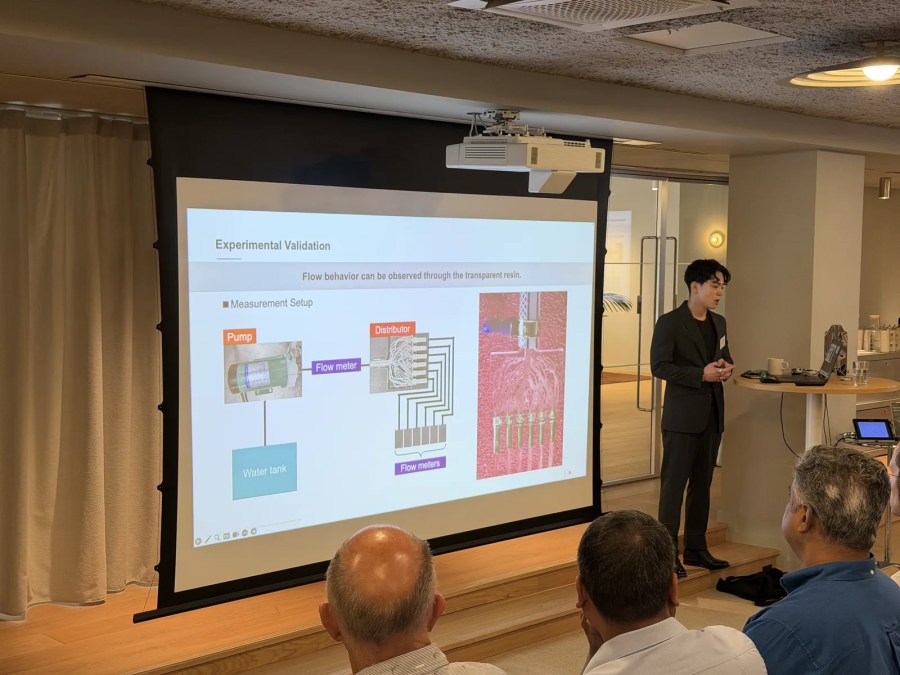
On behalf of Ricoh and SOLIZE PARTNERS, Soma Takeuchi (SCSK) presented two industrial cases. The first was a topology-optimized inverter heatsink, manufactured with aluminum binder jetting, that runs around 6.9% more efficiently while shedding weight — with only the fin structure printed, to keep additive material use down.
The second was a flow distributor optimized for uniform, efficient cooling, a deceptively simple component whose even flow underpins efficiency across oil coolers, fuel-cell units and chemical reactors alike.
And that was Takeuchi’s quiet, important point: even a component that looks simple can be tricky to optimize, because the flow inside it almost never behaves the way intuition promises. In each case the final geometry was not styled but derived: two clean examples of form following function, where the shape is simply what the physics requires.
Vincenzo Abbatiello of EOS drew the hardest slot of the day: the first talk after lunch, when a warm room and a full stomach conspire against any presenter and won it back with a running thread of memes that kept the audience laughing and, more importantly, awake.
Beneath the comedy was a serious argument. Drawing on EOS’s decades of additive manufacturing experience and its Additive Minds practice, which walks customers from first business case through design, simulation and qualification, he traced the full path from an idea to a serially produced part.
His talk was, in a sense, the connective tissue of the day: a practical and very funny account of how tools like ToffeeX slot into engineering workflows as they exist today.

Energy and SMEs: the hardest problems, solved against convention
Some of the most demanding work came late in the day.
Mark Jiskoot described developing an LNG vaporizer entirely against convention: cryogenic, operating near −160 °C, under vacuum and pressure, and explosion-proof. The physics is unforgiving.
LNG is transported close to its boiling point and expands by a factor of roughly 600 as it turns to gas; there is almost no pressure or temperature margin to play with, and if the sample partially fractionates on its way through, the measurement is already wrong. Underpowered vaporizers give themselves away in the most literal way possible: atmospheric moisture condenses and freezes onto them until they become blocks of ice.
Getting it right meant treating the vaporizer as a serious thermal-fluid design problem. Concentric heating in an annular space, smart Ex-rated heating control, and a geometry tuned to minimize both pressure loss and heat ingress as the LNG vaporized, expanded and accelerated, refined over five or six iterative review points, with lattice and machining challenges solved along the way.
Why it matters is commercial: with hundreds of millions of tonnes of LNG trans-shipped each year, small errors in measured quality translate into large swings in traded value. The result was a fourfold reduction in the variation of the measured heating value. A dramatic gain in stability and confidence, and the system is now fulfilling production orders.
The same approach, Jiskoot noted, applies directly to carbon capture, another field where representative measurement under punishing conditions is everything.

Alessandro Barraco and Leonardo Dal Re of BI-REX closed the applications by widening the lens to Italy’s small and medium manufacturers. BI-REX’s role is to bring frontier capability within reach of SMEs, and they demonstrated ToffeeX’s versatility across three very different heat exchangers: a natural-convection design that delivered roughly a 10% improvement in thermal resistance alongside a 12% reduction in weight; a dry-ice heat exchanger; and a cooling solution for additively manufactured electronics.
The point was not any single number but the breadth. The same tool, applied to problems that share almost nothing but their difficulty, by teams that do not have vast R&D departments behind them. That reach extends even to student engineering: the University of Bologna’s racing team developed their own heat exchanger with these tools, a story we’ve told in a dedicated case study on our site.

The common thread: generative design, now in production
Read together, the talks describe a shift. In each case, generative design was not the headline; rather, the outcome was: a tool that lasts twice as long, a heatsink that runs cooler and lighter, a vaporizer that measures four times more stably, a cold plate compact enough to fly. And in each case, the design was justified, manufactured and validated, not merely simulated.
That is what our co-founder Marco returned to in closing. The engineering world, he argued, is bracing for a wave of innovation pressure driven by decarbonization and electrification, and meeting it means starting from first principles, from the physics and the equations, with the engineer who uses the technology kept firmly in mind.
Generative design earns its place not because the geometries are striking, but because they let engineers explore a design space that classical methods cannot, and then carry the best of it all the way to production.
A community to be proud of
It would be easy to make a summit sound like a series of slides. This one did not feel that way. Talks ran long because the questions would not stop. Engineers from companies that compete with one another traded notes over coffee. And when the formal day ended, people who had been traveling since the day before stayed for the drinks and fun chats.
Thank you to every speaker, guest, and team that made the first ToffeeX Summit what it was.


